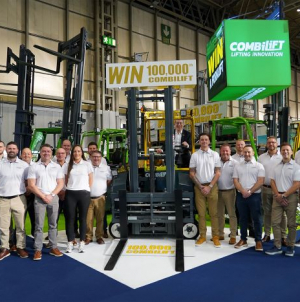
Paul Murray, JCB’s Teletruk general manager
Flooring service
According to a recent report by the Urban Transport Group, some 3.8 million vans (goods vehicles below 3.5 tonnes in weight including their cargo) are now registered in the UK.
This figure reflects an increase of 74 per cent since 1996 – with vans now representing 15 per cent of all motor vehicle traffic.
A number of factors are thought to be driving this growth, including the ever-upward spiral of the online shopping market and the resultant need to deliver internet shoppers’ orders – particularly to those consumers living in the most densely populated conurbations.
For any logistics company, running a van fleet can be a costly exercise. Tax, fuel, maintenance and insurance, all add up to significant expenditure for any company, large or small, so its important that businesses do whatever they can to minimise these costs.
Clearly the aim of any fleet manager is to ensure that vehicles are off the road for the shortest period of time possible and, to this end, ongoing maintenance regimes and driver training programmes both play a key role in cutting the amount of time that vans are out-of-action.
However, perhaps surprisingly, one of the most common causes of lost van ‘up time’ is not an engine fault deriving from poor maintenance or damage resulting from reckless driving: it is bodywork damage inflicted by poor load handling and loading techniques.
In simple terms, when it comes to van loading it is common practice for a small counterbalanced truck or pallet truck to be used to lift a palletized load into the back of a vehicle. The pallet is then often ‘slid’ into the van’s storage space either manually or using the forks of the lift truck.
But, as many fleet operators have found to their cost, there is a significant likelihood that a wooden pallet (with the inevitable protruding metal fixings) that is slid into the back of a van will often rip into the vehicle’s flooring – causing significant damage that is both costly and time consuming to repair.
But more and more logistics operators and courier firms are eliminating this problem by introducing JCB’s Teletruk technology to their operations.
Thanks to its unique telescopic mast design, which gives a forward reach of 2.4 metres, the Teletruk can deliver a pallet to the far end of a delivery vehicle without touching the floor, until the pallet is gently lowered in to position. In this way, the Teletruk greatly reduces the risk of load and vehicle damage and, of course, eliminates the risk of injury associated with manually handling loads in to vehicles.
With today’s technology-enabled consumers demanding that their online orders arrive within hours of clicking the ‘buy now’ button, there will be no let up in the rise in the number of journeys delivery vans are required to make. So fleet managers are likely to find themselves under grater pressure than ever to keep their vans on the road and eliminating unnecessary damage during the loading process should be part of their planning.