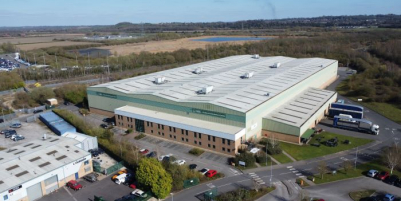
Histon Sweet Spreads Ltd (part of the Hain Daniels Group) produces some of the country’s best known preserve brands, including such staples of the British breakfast table as Robertson’s ‘Golden Shred’ marmalade and Hartley’s jam.
The company’s production facility in Cambridgeshire is in operation 24/7 and some one million cases – or 1500 tonnes – of product is manufactured at the site each and every week.
With residential property bordering the busy operation Histon Sweet Spreads go to great lengths to minimise the amount of noise generated by arriving and departing delivery vehicles and other essential activities that might disturb or disrupt their neighbours.
“A certain amount of noise from commercial or industrial premises is to be expected but we have always been very aware of the fact that excessive or unreasonable sound could constitute a problem for the people that live in the houses nearby, especially if the noise continues through the night,” explains Danny Ivatt, Histon Sweet Spreads’ Site Services and FLT Supervisor.
When a resident of one of the domestic properties that adjoin the production site’s boundary drew Histon’s attention to the noise created by a lift truck that uses an unmade road to shuttle between different areas of the site, Histon Sweet Spreads immediately set about finding a way to nullify the problem.
The company consulted its long-term materials handling equipment provider Toyota Material Handling (UK) for a solution.
Studies undertaken by Toyota highlighted that it took the lift truck six minutes to cover the distance between the site’s ‘jelly line’ and the finished goods warehouse. Once a pallet of ‘jelly’ had been deposited within the finished goods store, the forklift made the return journey – which involved another six minutes of travel time.
With loads coming off of the ‘jelly line’ at a rate of 5 or 6 per hour the lift truck’s 12 minute return trip to the storage unit and back via the rough surface of the road often meant the truck operator was up against the clock.
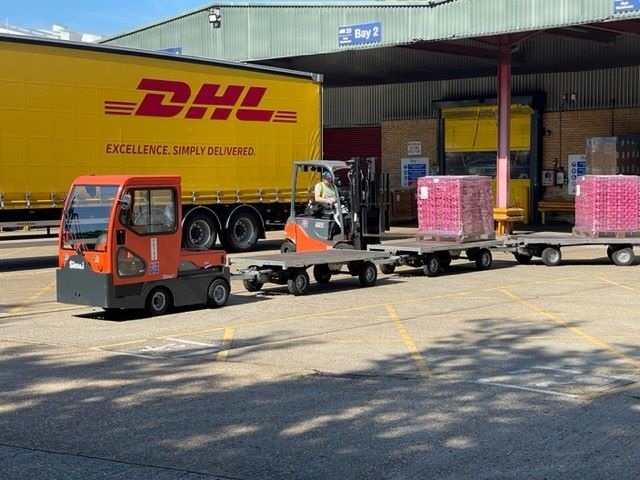
Toyota recommended replacing the forklift with a tow tractor. Because a tow tractor fitted with a trailer allows several loads to be transported by one vehicle, the number of journeys between the ‘jelly line’ and the finished goods store has been cut to one every hour, instead of the five or six 12 minute forklift trips that had previously been necessary.
Furthermore, an immediate noise reduction dividend comes courtesy of the elimination of the sound produced when the forklift’s mast is raised or lowered, due to the simple fact that a tow tractor doesn’t have a mast!
The tow tractor supplied is a Simai 4-wheel sit-in model with an 8-tonne capacity. The electric-powered machine’s robust design is better suited to the terrain of the unmade link road than the fork truck, which means Histon’s monthly service costs have been reduced.
And, because the tow tractor is only required to make one return trip per hour, it is also being used to manage the movement of waste and empty raw material barrels around the site. This has allowed Histon to cut the number of hours each of the six trucks in its gas-powered counterbalanced forklift fleet has to work in and around the yard area – further reducing noise pollution.
Toyota report that, driven by changing manufacturing trends, sales of tow tractors are increasing across its business.
“Many manufacturing companies are reconfiguring their internal logistics systems to maximise efficiency of lineside parts delivery processes,” says Toyota Material Handling Senior Sales Executive, Ronnie Finney.
He continues: “In a lot of cases, manufacturers are adopting the ‘milk run’ principle as the most efficient way of getting parts to the production line. This involves delivery of parts on a defined route around the factory, often to a set timetable.”
“In simple terms, tow tractors leave the warehouse with a full load of parts. They drop off a full SKU of parts at the production line and take-away an empty SKU for replenishment. This system was first used in the automotive sector but is being adopted by smaller companies across a range of industries as the ‘scheduled’ parts delivery service approach gives greater structure to the production process.”