By Coreen Merryweather, Client Development Director of TGMatrix, which provides fully-automated, digital freight matching for shippers and carriers.
The freight industry is not short of ‘load boards’ that claim to match spare carrier capacity with shippers’ requirements. But load boards have significant shortcomings – they are at best only partly automated, they lack intelligence, and they don’t actually make matches.
Testing against criteria is limited
Like other search sites, such as dating and property, load boards try to pair supply and demand by testing against several criteria. For property, searches may be by price band, number of bedrooms, location, off road parking, etc. For freight, it could be times, start and end locations, weight/volume and other factors. If a data set fails one of these go/no go tests it is rejected or pushed down the rankings. Typically, these systems struggle to produce a ranking based on more than one criterion.
Critically, the output is also not a best match, but merely a list of offers that meet all or some of the requirements. The laborious process for the system user is to balance significant or conflicting factors objectively, to decide if and where compromises might be acceptable, and even whether to rerun the search with different requirements. Then, of course, there is the issue of the shipper and vendor having to manually agree prices and contracts.
Interaction needs to be realtime
A further problem is that shippers and carriers are often not interacting in real time. Someone must create and upload details of requirement/capacity and take them down again, but timing is everything. By the time the shipper has manually evaluated responses, the carrier capacity may already have been reassigned. Very short-term opportunities may never make it onto the board at all, and most postings are ‘last resort’ rather than ‘first opportunity’.
The entire process is long-winded, labour-intensive, costly and slow, yet still does not guarantee finding the best possible match.
Digital freight matching, does the work for you
What is needed is an intelligent, digital system designed for the digital freight world – not just a better load board. It will use machine-to-machine (M2M) interfaces to capture and upload shipper requirements and carrier availability, as soon as they are defined or changed on the users’ own systems and supplemented by stored cross reference (x-ref) data.
Using an intelligent algorithmic approach, the system would discover best matches based on the full range of shipper criteria, ranging from corporate framework to load or lane specific requirements – all against defined business rules.
Using carrier charging data and information on road networks, congestion etc, (all based on vehicle profiles) the system would optimise routes. Additionally, where required, other factors such as transit time, performance, carbon emission and price can be factored in, weighted according to need. While ever the requirement is ‘active’ (and unless first match has been chosen), with each change of shipper requirement or carrier capacity, the system continuously re-evaluates all opportunities to create the best match.
Such a system is fast, ‘always on’, always communicating and always working with live data. There are no capacity limits to the number of potential pairings it can analyse, and it can apply rules to the weighting of multiple factors, in an objective way with no commercial inducements. Costly, time-consuming and error prone manual processes are eliminated. And significantly, with machine rather than human matching, users do not have to post commercial information for all to see.
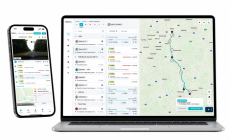
Thankfully, such a Digital Freight Matching process now exists and forms the core of TGMatrix’ intelligent freight solution, bringing shippers and carriers together in a digitalised age in a seamless process that delivers easily realisable benefits.
For further information visit www.tgmatrix.com